

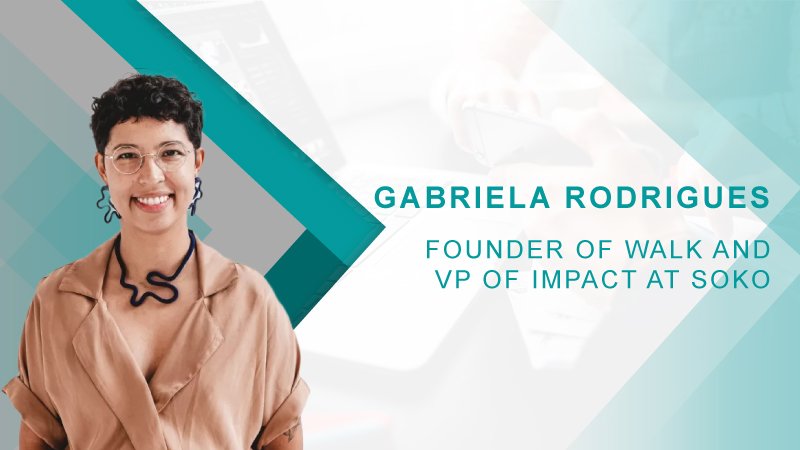
Hi Gabriela, delighted to have you join us. Could you briefly share your journey from founding Walk to your current role at Soko?
I have a degree in electronics, advertising, and Neuroscience. Therefore, I’m always trying to find the science behind communication. I started my career in strategy, an area where I worked for more than 10 years. Then, I became a creative director with a very clear point of view about the type of campaign I wanted to do (the type that sees people as humans and not only as consumers). Years later, this desire led me to the position of vice president and, more recently, to creating and launching WALK, a Soko spin-off that combines the depth of a consultancy with the creativity of an agency in building and strengthening impact platforms for the world’s boldest brands with the mission to change advertising and the society for better.
Walk’s mission is really intriguing. How does it address negative imagery in marketing, and what’s its vision for reshaping the advertising landscape?
Have you ever stopped to think about the volume of advertising you see each day?
Every day, we see thousands of campaigns. And probably 99% of them don’t hold your attention. In a world full of humanitarian crises like ours, thinking about social impact is thinking about a way to attract attention and build brand relevance.
With WALK, we want to create an advertising industry that is truly relevant to people and society. This will also be good for brands because it will strengthen their positioning, increase the relevance of their messages, and help a lot in the fight for attention that they currently face.
Could you discuss how Soko’s partnership with the Unstereotype Alliance might influence the advertising industry, and what key steps are necessary for achieving its goals?
The Unstereotype Alliance is doing very serious work alongside brands from different countries. Soko is one of them. As a member of the Alliance, we can accelerate change, talk about the mistakes that have already been made in our industry, and also have access to the most advanced conversations about the social role of communication. But we are going further: we created an unprecedented and public commitment to show the industry that it is possible to do more:
COMMITMENT LETTER
Over the last nine years, Soko has been creating brand stories that are deeply connected to culture and society. But being connected to society also means understanding its urgencies. That’s why, together with UN Women and the Unstereotype Alliance, we are committed to:
● Showing the market that it is possible to make communication a tool for improving
the world, by creating a structure 100% focused on building social impact through advertising;
● Making advertising a tool to change the way people dream, desire, and consume, and in doing so, initiate a process of greater change in our society.
● Creating brand stories and internal processes capable of changing people’s relationship with themselves and others, increasing empathy, visibility, and self-esteem, and consequently helping to reduce intolerance towards what is diverse.
● Working with intentionality in order to create campaigns that break down stereotypes of race, gender, sexual orientation, gender identity, age, disability, and any others that can be harmful to people and the world.
● Preparing our team and having frequent exchanges with clients and partners so that they are aligned with our values and well-prepared to engage in dialog regarding the same goals.
● Encouraging our clients and partners to get closer to the Unstereotype Alliance in Brazil and around the world in order to increase their commitment to the agenda.
Your perspective on diversity in advertising must be insightful, especially as a woman of color and member of the LGBTQI community. How have your experiences shaped your views?”
I had a lot of difficulty getting into big agencies. When I got my first job, I suffered homophobia, and racism and heard a lot of jokes about the fact that I was poor and didn’t have the same clothes and experiences as other people. At that moment, my goal was to prove that I was a good professional, even though I was different from other people. As the years passed, I became a manager, and it was then I realised that I had also become an example for other young people who were starting their careers. From that moment on, my goal changed: I’m here to help change the industry so that more people like me can exist in it. Today, this goal is in everything I do. Last year, for example, I mentored 39 young talents, all of whom are people of color.
Can you explain how Walk uses marketing to promote social good? Any standout campaigns that have driven positive change?
First, we help the brand understand its social territory by studying the mission, vision, purpose, and especially all the real actions of each company. Then, we help the team understand what level of maturity the brand is at, analysing, for example, whether this is an allied brand or if it is just responding to social pressures.
– according to our proprietary methodology. With a little science in hand, we design the best strategy to follow and how it will be measured.
But why are we doing all this? Because there is a lot of money in the hands of marketing and this money can be at the service of people, improving society and nature – if it is proven to be also good for the brand. We exist to prove that the positive impact will also return to brand performance. Some examples of our campaigns, created by SOKO using WALK’s Methodology:
Dove – A Seat in the Sun, a campaign that created accessible chairs for obese people;
Sunsilk – Tiana, a partnership with Disney to loosen the hair of Tiana, the only black princess, and help improve the self-esteem of black children;
Stella Artois – Uncomfortable Food, a brand platform that aims to increase gender equity in gastronomy.
Speaking of diversity, why do you think it’s so important in advertising? And how do you think the industry can do a better job of representing diverse voices and perspectives?
Neuroscience has already proven that groups of different people come up with more solutions to the same problems. The logic for advertising is the same: there is no way to create innovative stories that have the power to reach massive audiences without having diversity in the teams. More diversity generates more repertoire which, in turn, generates more innovation. The industry needs to hire more. Colleges need to train more. This is the future and our actions need to happen now, in the present.
For aspiring professionals wanting to prioritize social impact and diversity in their advertising careers, what advice would you offer?
Study. Changing the status quo requires a lot of grounding and energy because people will question you all the time. But believe in your heart. Nothing is more powerful than a work done with purpose. And if you need to talk, call me on Instagram (https://www.instagram.com/gabirodrgs), I’m here for you.
Integrating social impact into advertising can be challenging. What strategies have you found most effective in this endeavor?
Bringing science to an area that today is still guided by a lot of opinions. We spent more than a year creating the WALK methodologies and metrics for this reason. Today, we can reassure brands and explain that backlash is part of the process, for example, and that the most important thing is to know who you are and act in accordance with the brand’s truth.
Every journey has its hurdles. What were some major challenges you encountered in promoting social impact and diversity in advertising, and how did you navigate them?
The major Challenge is the fear that brands have of making mistakes and experiencing a backlash. What I try to show is that strong brands, like Nike, Dove, Burger King, and Patagonia also go through this, but they know how to act because they know who they are before anything else. My job is to build more brands like this and show that fear is an ally of innovation.
Looking ahead, what are your hopes for the future of advertising in terms of driving positive social change and embracing diversity?
I see a more mature world, where brands understand their role in society beyond talking about diversity once a year or posting a black square in the Instagram feed when a black person is murdered, as happened in the George Floyd case. I see a world where social impact is measured and proven as a result for people and brands. I see a world where young people will be really proud to say they work in brand communications.
Explore HRtech News for the latest Tech Trends in Human Resources Technology.