



Organizations typically have two methods to employ the OKR framework at work. While the OKR spreadsheets method was frequently used initially and is still commonplace in some small-sized businesses, automated OKR mechanisms drive the majority of large-sized companies’ functioning today. Much like every other technique, each of these methods have their benefits and downfalls. But how can an organization decide which among the two is best considering the particular company’s ideology, culture, policy, strategy and employee relations? All you have to do before diving into employing the OKR framework is skim through this blog that will guide you on the technique among these two to suit your company best!
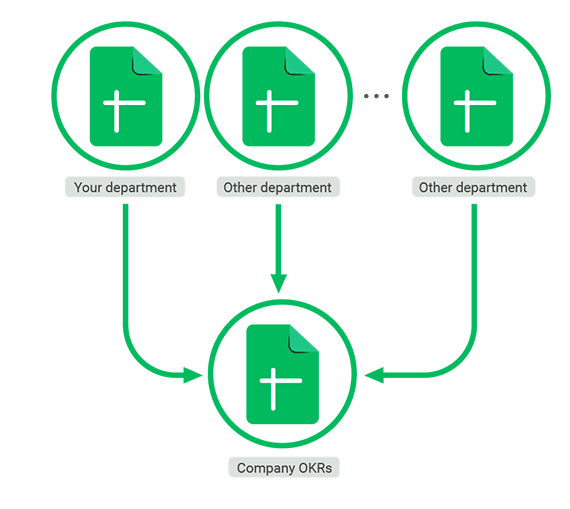
What are OKR Spreadsheets?
For start-ups and small-sized teams with less than 25 employees, an OKR spreadsheet in Microsoft Excel or Google Sheets is a simple way to make organizational goals transparent and measurable. Spreadsheets allow small teams to set, track and align their goals using the OKR framework. Spreadsheets are without doubt, a great tool for getting started with OKRs since they help organize personal and small-team OKRs. Employees can make a copy for themselves where they regularly add goals and track their achievement. This is a great method to get the entire team engaged by increasing collaboration and teamwork on a single OKR sheet.
What really sets OKR spreadsheets apart is its ease of use. To get an employee to be constantly motivated to achieve his targets, it is crucial for the goal-setting tool to be comfortable and easily accessible lest people feel overwhelmed and face the daunting task of using another tool.
This manual mode of setting OKRs equips you with all the skills you would need to create an automated OKR tracking system. Moreover, everyone has easy access to spreadsheets that are available free of cost. Spreadsheets are also flexible since they can be easily edited and this is what makes them convenient like never before! It also lets employees get a holistic view of what an individual’s Objectives and Key Results look like from a macro-company level.

OKR spreadsheets contribute in making an individual or team’s objectives SMART –
- S – Specific
- M – Measurable
- A – Achievable
- R – Realistic
- T – Time-bound
By keeping each of the factors of SMART objectives in mind and sharing them with the team, any potential confusion or miscommunication that may arise among employees with respect to what is expected of them can be avoided. Needless to say, each objective should be assigned to one person or a team. In addition to this, it is best to be crisp and well-detailed while assigning tasks lest anything be missed, shelved or be given to the wrong employee.
With OKR spreadsheets, four possible tasks can be done at the click of a finger –
- It allows to keep track of all objectives of the department in one place
- Spreadsheets monitor the progress of each Key Result pertaining to each team member
- Viewing the actual progress at a glance becomes possible
- Comparing the total average progress with the desired progress
Problem with using OKR spreadsheets
Although spreadsheets were where OKRs found their origin, the biggest problem with this technique is its implementation. Manually typing in OKRs for various organizational levels can be a time-consuming process, which might end up defeating the purpose of quick, smooth and engaging OKR management. The monotony in just setting up OKRs can reflect in fewer employees actually accomplishing their goals.
Research conducted on the effectiveness of OKR spreadsheets have also shed light on the fact that spreadsheets can be at times hard to constantly manage with no reminders and to-do’s. It was also found that some employees found the OKR tracking complex, hard to update and tough to follow on spreadsheets, which resulted in people checking OKRs only at the end of the quarter.
The pain of using outdated spreadsheets led to disengagement in people. Although there is no doubt that OKR spreadsheets are a good beginning, one needs to recognise the fact that they are quite limited in features compared to a dedicated software tool.
What are automated OKRs?
For more than 25 employees, since spreadsheets don’t provide the level of transparency and usability that is desired, an automated OKR tool is recommended. In case of automated goal-setting and tracking of OKRs, the manager would have a complete overview of every team’s progress towards their goals.
While team members update their OKR progress in their own spreadsheet, data of individuals or teams automatically gets transferred into the manager’s OKR recording sheet. Automated OKRs make goal-setting tidy and streamlined like never before! Digital updates across sheets in real time prevents employees from wasting time on manually writing their progress on multiple spreadsheets. An ethical part of automated OKRs is also that it upholds employee privacy. In other words, employee performance confidentiality is respected by letting only the manager see each team member’s OKR.
Why is it better to move from OKR spreadsheets to automated OKRs?
According to a research conducted on use of automated OKRs, about 75% of companies that were initially using spreadsheets gave up and switched to the automated version due to a plethora of advantages of the latter. It was also noted that the main reason why people started using OKRs on spreadsheets was because it was free. However, after prolonged use is when managements around the world realized that cheaper isn’t always better!
The 6 main benefits of using an OKR software in place of spreadsheets are –
- No need to manually set up an OKR template
The OKR software is designed in a way to have a pre-filled out template, where managers can easily insert self and employees’ Objectives and 3-4 Key Results. The software also permits the addition of a custom measurement unit to any key result.
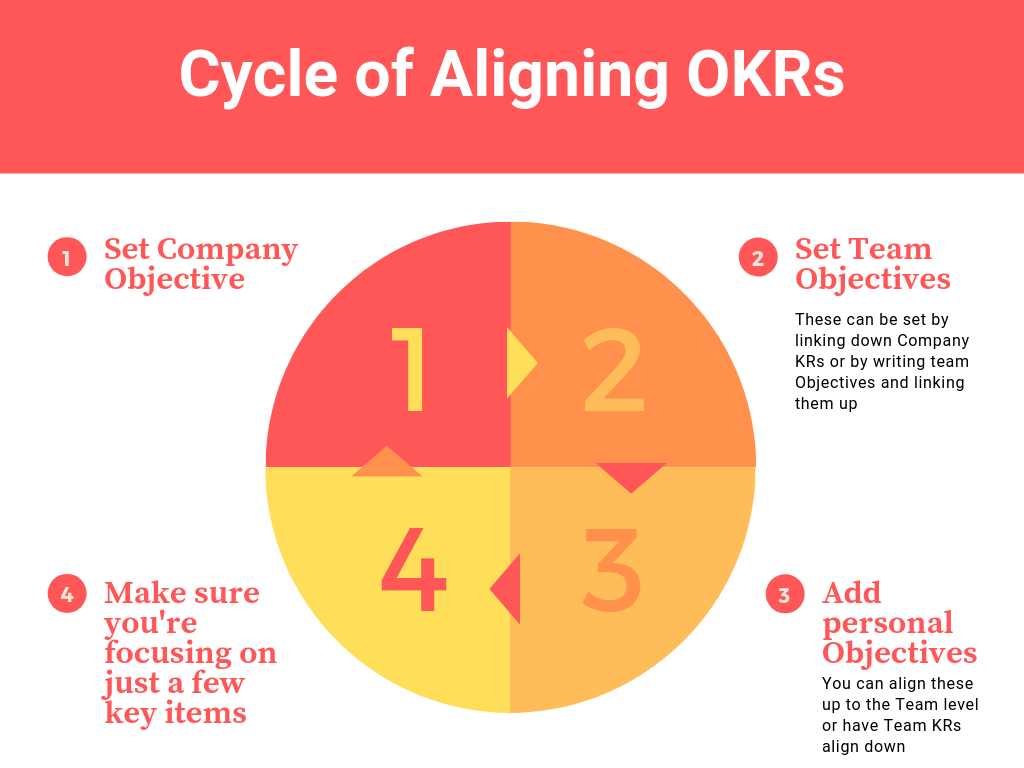
- Linking personal Objectives to team, department and company Objectives becomes possible
For people to understand how each team member’s role makes a difference and a positive mark on the whole company, OKR linking between organizational tiers is essential.
This enables alignment between individual employees’ goals and company-wide objectives. With the help of automated OKRs, the ones up in the hierarchy can get a bird’s eye view of everyone’s goals.
- Easy to follow and update OKR progress
This aspect addresses the biggest pain point of OKR implementation that arises with using spreadsheets. One click on the OKR automated sheet, and a progress update becomes possible! What’s more? Should the OKRs be linked to other employees’ OKRs, instant changes are visible there too. You wouldn’t miss out on any progress updates with notifications buzzing your phone!
- Visual dashboard enables viewing your OKR progression
Automated OKRs provide each employee with a personal dashboard that permits easy tracking of allocated OKRs. Be it your progress on an individual, team and company level or whether you have gone off-track or have exceeded expectations, you will be able to notice the trends in a statistical format. Can this get any better?
This holistic view of each one’s progress helps managers make better, informed decisions in the future. The high-level visibility permits the higher-ups to take actions accordingly e.g. have a 1:1 conversation with an employee, etc.
- Commenting and providing feedback on an individual OKR becomes possible
Automated OKRs permit commenting on a single Objective and an individual Key Result. Peer feedback and co-worker advice is commonplace, which not only results in greater collaboration but also exposes the team to multiple perspectives to approach one particular situation.
- OKR experts are at your beck and call to help you
An automated OKR tool tags along with 24/7 customer support from the OKR experts. Human Capital Management softwares like peopleHum that boast the OKR feature have experts working behind the scenes to constantly update and make it better and user-friendly. With peopleHum professionals by your side, you can surely make the OKR magic happen!
From creating a time-bound objective to be met on the self, team and organizational level to getting peer feedback on OKRs, this feature in peopleHum is a wholesome and indispensable tool for employee management. Checking in on team members’ performance and tracking progress consistently also gives the manager an insight into high and low performing employees on a quarterly basis. See the whole OKR tree diagram on a single screen to know what your team is working on and check if the allocated goals are aligned with your organization’s vision and mission, only with peopleHum!
Common OKR mistakes
Despite the technique of using OKRs i.e. spreadsheets or automated, humans often fall prey to common OKR mistakes. How is it that this can be significantly reduced and eventually evaded? Here are some basic tips to counter errors in OKR implementations.
- Setting non-measurable Key Results
OKRs albeit ambitious need to be measurable and attainable since it is a representation of your top priorities.
- Including tasks as Key Results
While a task is an activity that you do, a Key Result is the successful outcome of what was done by you as part of the task. It serves as the goal or purpose why the task was carried out.
- Following a top-down OKR setting method
The purpose of having OKRs was because it wanted to do away with the traditional top-down approach. Reproducing it would only defeat its whole purpose. It is crucial to trust teams and individual members to set their own OKRs that are ambitious yet realistic. Rather than following the cascading method, the bottom-up approach of OKRs ensures individual accountability.
- Never create OKRs in silos
OKRs call for more collaboration between team members. Should goal-setting be done in silos, there would be no alignment between vision and purpose, team tasks and company goals, etc.
- Do not “Set it and forget it”
OKRs demand regular monitoring and tracking. Since it forms a part of the culture of the organization, it requires consistency in use.
- Including OKRs in a compensation formula
OKR is a management tool and not an employee evaluation tool. It aids in improving employees’ performance and contributing to worker skills but isn’t a deciding factor on who gets compensation and who doesn’t.
Wasn’t that a roller coaster journey through OKR spreadsheets to automated OKRs? Can’t get enough of it? We can’t stop talking about it too. Do not miss out on the last part of the OKR series to bring closure to your knowledge stock on OKRs. There are more exciting parts to OKRs that are waiting for you. Check it out before it is too late!
For more such Updates Log on to www.hrtechcube.com
ABOUT THE AUTHOR

PeopleHum
peopleHum is an end-to-end, one-view, integrated human capital management automation platform, the winner of the 2019 global Codie Award for HCM that is specifically built for crafted employee experiences and the future of work. It is the next-generation people engagement platform for becoming future-ready with its predictive analytics.