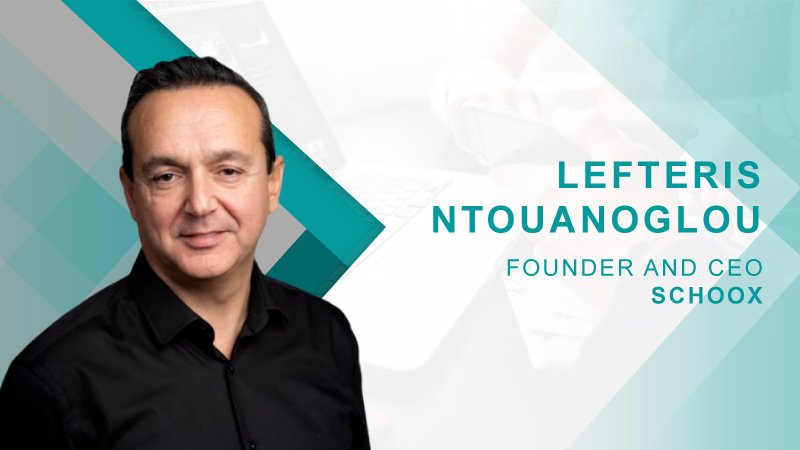
Welcome to HRTech Cube, Lefteris. We’re delighted to have you. To begin, could you share a bit about your professional journey — what inspired you to found Schoox, and how your background led you to reimagine how organizations approach learning and development?
Thank you for having me. I started Schoox in response to a simple observation: while few business leaders would deny that there is value in educating your employees, few learning and development leaders are able to deliver learning that can demonstrate a direct link to business impact. I come from a technical and academic background, including a PhD in computer science, and I’ve always been fascinated by how people absorb information, how they build skills, and how technology can support real performance.
What I saw in the market at the time was a reliance on systems built around tracking and compliance, not actual learning. It felt like an opportunity to solve an unmet need. Organizations were spending enormous amounts of time and money, but not seeing meaningful outcomes. Schoox was born from the belief that learning should be human-centered, tied to the realities of work, and capable of driving measurable business value. That combination of research, engineering, and a deep interest in human behavior is still the foundation of how we engineer today.
Schoox has become known for transforming traditional learning into measurable business outcomes. Can you explain how starting with business goals like revenue, retention, and growth helps companies build more effective learning strategies?
Learning can only be strategic if it’s connected to the business goals and initiatives that organizations are trying to achieve. When you start with goals — faster onboarding, higher sales, fewer errors, better retention — you can work backward to determine which skills matter most and how training should support them.
Most organizations do this in reverse. They build training, deliver it, and then hope it moves the needle. We help them flip the model: define the business outcomes first, identify the skills that influence those outcomes, and design learning programs that directly support performance goals. When learning is aligned this way, it becomes a lever for growth, not an obligation.
Examples of flipping the model and achieving tangible results are Sport Clips which reduced time-to-productivity for new hires by 63% by aligning onboarding to the skills that drive store performance. And Biscuitville increased employee retention by 30% by connecting development directly to career paths and on-the-job performance.
When learning is built around actual outcomes, not just delivering training courses, adoption improves and results follow.
Many organizations still view Learning & Development as a cost center. How does Schoox help change that mindset — turning L&D into a profit-driving function that directly impacts business performance?
L&D is often misunderstood because its impact isn’t always measurable. If success is defined by completions and course hours, it’s hard to defend budget or tie learning to value.
We help companies shift from activity metrics to performance metrics. We use data to show how training improves the skills that directly impact objectives like: productivity, retention, safety, sales, or guest satisfaction. Our customers routinely see measurable improvements across onboarding, retention, and operational accuracy. When learning can demonstrate that level of impact, it shifts from a cost center to a strategic business partner.
AI is reshaping every corner of the workplace. How is Schoox leveraging AI to automate skills mapping and content creation, and what efficiencies does this bring to modern learning teams?
AI helps us solve two problems that have challenged L&D teams for years: understanding what skills truly matter for each role and creating the right training to support them at scale.
Our Learning Impact Suite was engineered with AI to analyze the skills required for each role and connect them to the business metrics they affect, from sales and waste reduction to faster onboarding and stronger customer service. From there, we build Impact Profiles to quantify the expected value of improved performance. Connecting skills required for a role with the performance metrics that matter most enables teams to see exactly where skill gaps exist and what those gaps mean for the business.
Once those relationships are clear, AI generates the learning plans and content needed to build proficiency. Instead of long, generic courses, teams can produce purposeful, targeted training that increases specific skills – on brand and based on a company’s actual requirements. That alone can reduce development time dramatically and keep courses far more relevant.
The result is that L&D teams spend less time creating materials from scratch and more time focused on strategy, and for many organizations, it’s the first time they’ve been able to connect skills, training, and business outcomes in a single, continuous workflow.
Learning becomes strategic the moment you can show how building a skill moves a business metric. When that link is clear, L&D stops being a cost center and becomes a growth engine.
Measuring the return on investment for learning programs has always been a challenge. How does Schoox use real-time analytics to forecast and track ROI, giving leaders visibility into how learning drives measurable outcomes?
This is one of the core problems we built the Learning Impact Suite to solve. For years, L&D teams have lacked a clear way to connect learning activity to performance, which makes it nearly impossible to answer the question, “Did this training actually move the business forward?”
With the Learning Impact Suite, organizations can now see that connection end-to-end. The Suite creates Impact Profiles that tie each role to the skills that matter most and the business metrics those skills influence. When employees receive training that improves proficiency in those skills, leaders can see how improvements correlate to performance in real time.
Because all the data lives in one system, the Learning Impact Suite can also forecast outcomes. It projects the value of closing specific skill gaps, from faster ramp times to reduced waste or stronger revenue and guest satisfaction. Customers are already using these insights to decide where learning investments will deliver the greatest return.
Once you have both real-time impact and forward-looking insight, the conversation around learning changes completely. It becomes a strategic decision supported by data, not a cost center hoping for recognition.
Schoox works with leading brands like Big 5 Sporting Goods, Westgate Resorts and Pacific Seafood. What are some of the key results or success stories you’ve seen from these early adopters of your platform?
Customers see faster onboarding, higher engagement, and measurable improvements in performance. In many cases they reduce administrative work by half. In others, sales go up because employees are better prepared. And for companies with large frontline populations, simplifying training and making it mobile-first has an immediate impact on retention and productivity.
The common thread is that when people understand what’s expected of them and are given the right training and reinforcement to grow, performance follows.
Our customers span industries, but the themes are consistent: faster onboarding, stronger performance, and better retention.
Recent customer examples include:
- Pacific Seafood reduced turnover among returning seasonal workers from 38% to 14.8% and improved promotion readiness by 26% using role-based, multilingual training.
- Friedman’s Home Improvement cut time creating compliance training by 90% and saved 70 hours per week on administrative reporting.
- Sport Clips achieved 63% faster onboarding and a 5% increase in manager retention.
- Biscuitville Fresh Southern saw 57% faster time-to-productivity and a 30% increase in retention.
- The Fresh Market boosted sales of new products by 20% with mobile-first training.
These results aren’t outliers, they’re consistent with what happens when people understand expectations, receive timely support, and build the skills that matter.
The link between skills development and employee retention is stronger than ever. How can organizations use learning as a strategic lever to improve engagement, performance, and long-term retention?
Retention improves when people feel supported, capable, and connected to their work. Skills development plays a direct role in that.
Frontline employees, especially in restaurants, retail, and hospitality, want clarity, confidence, and a path forward. When organizations offer structured learning that meets their needs, sets clear expectations, and shows real opportunities to grow, people stay longer and perform better.
In fact, we recently conducted research on this topic with Lighthouse Research & Advisory and the data is very clear:
- Workers who feel they have the right training are 3x more likely to stay with their employer.
- Employees who plan to stay are twice as likely to say they know what’s expected of them.
We see this play out across our customers. Team members who feel they receive the right training are significantly more likely to stay with their employer. Learning is one of the strongest retention tools available, and it’s often the most underutilized.
On a personal note, what leadership principles or strategies have guided you in scaling Schoox and driving innovation in the learning technology space?
I’ve always believed in building products that solve real problems for real people. Technology only matters when it simplifies work, removes friction, and creates opportunity.
I also believe in staying close to customers. Many of our biggest product innovations came directly from watching how people learn on the job, especially frontline workers who rarely sit at a desk. If you pay attention to their experience, you design differently.
And finally: stay curious. Learning doesn’t stop at school or in training modules. It drives careers, cultures, and companies. That philosophy is at the heart of Schoox.
For HR and L&D professionals looking to modernize their learning ecosystem, what advice would you give on aligning training initiatives with measurable business goals?
Start small and stay focused. Pick one business problem, whether it’s speeding up onboarding, improving customer service, or reducing errors, and map the skills that influence that outcome. From there, design training, and the necessary reinforcement to drive proficiency, that directly supports those skills and measures the results.
When leaders take this targeted approach, alignment becomes much easier. It also builds credibility. Once the business leaders see measurable improvements, they gain momentum to expand the L&D strategy.
Finally, Lefteris, any closing thoughts you’d like to share with our readers about the future of AI-driven learning and how Schoox is helping companies build smarter, more adaptable workforces?
AI is creating an opportunity for L&D that we’ve been waiting for: the ability to personalize learning at scale and tie it directly to performance.
To be clear, AI isn’t replacing the learning function, it’s elevating it. It frees teams from manual work, helps them make better decisions, and finally connects learning to the business outcomes that matter.
Our mission at Schoox is to ensure companies can build workforces that are adaptable, confident, and ready for what comes next. Skills will continue to evolve; industries will continue to shift. When learning is connected to impact, organizations can navigate that change with clarity and confidence.

Lefteris Ntouanoglou Founder and CEO of Schoox
Lefteris Ntouanoglou founded Schoox to disrupt the learning and talent development market by creating a mobile-first solution built for business with learner development as the foundation. As Founder and Chief Executive Officer, he has steadily grown the company while overseeing the development of Schoox’s innovations. Prior to founding Schoox, Lefteris held a variety of product and technology leadership roles in software development. He studied Computer & Electrical Engineering and earned a PhD in Diffractive Optics – Computer Generated Holography from Aristotle University of Thessaloniki in Greece. He also holds an MBA. Lefteris has a passion for knowledge and is on a mission to demonstrate the value of lifelong learning.