


Welcome to HRTech Cube, Rohan, we’re delighted to have you. To begin, can you share your professional journey and what led you to Guild?
Thank you for having me. I’ve spent my career developing products where a technology shift was the underpinning. As part of the founding team at CricInfo, we leveraged the possibility of the Internet reshaping media and content. Yahoo! During the search and ads era; Telenav as mobile moved from novelty to default. In each case, it became clear that the companies that win aren’t just the ones that recognize the shift, it’s the ones that build for it at an infrastructure level. What drew me to Guild was the mission, and an opportunity that aligns at the foundations. The shift isn’t just AI, or remote working, or skills-based hiring – it’s that workforce mobility, and how people move, adapt, and advance, will determine the future for both companies and workers. Traditional HR tech was not built for that problem – but Guild was, and is. I came to Guild to take a strong foundation – a platform that already changes lives – and make it the durable and scalable infrastructure layer for workforce development. It’s a hard combination to find, and it’s exactly what’s worth building.
How did your team simplify tuition reimbursement from a complex and fragmented global system into a more unified solution?
Education benefits, including tuition reimbursement and tuition assistance, are one of the messiest and most underutilized benefits in corporate America. Companies spend billions offering them, and fewer than 5% of eligible employees take advantage of them. This has been a design failure. Tuition reimbursement specifically was predicated on an assumption that the problem to solve was an accounting one, when actually the difficulty is in everything around that. Are you eligible? What program should you choose? Getting approval. Processing claims. Understanding policies. Trusting that you’ll get your out of pocket expenses back. We have built a system that collapses all that complexity into one platform – no more fragmented tools or disconnected workflows – but maintains the flexibility that employers need in the system. Eligibility, claims processing, approvals, policy compliance, and employee support all live in one place. AI handles the administrative overload. And for global teams, localization is architecturally supported so that a region-specific workflow can be equitably delivered everywhere. The result is a system that is faster to stand up, easier to manage, far more accessible, and delivers on a promise that was made many years ago.
What challenges do organizations face when delivering learning programs across global teams?
As I’ve noted, the problem is architectural. Organizations typically hope or assume that their base program (often the US based product) will just translate over, or they build more bespoke programs in each region that are then disconnected and cannot be measured against one another. All tuition reimbursement programs have to touch on compliance, though the specifics are different in each country. They touch localization, but the policy and language will vary by region. They touch socio-cultural expectations, and again a frontline employee in India likely has different expectations from one in, say, Mexico. The true test is whether frontline workers in Mumbai, Memphis, and Mexico City all have the same fundamental opportunities for advancement. Most companies would likely honestly answer that with “no,” and that’s the gap we’re closing.
Why has AI skilling become so urgent for today’s workforce?
Everybody will tell you that their workforce needs AI fluency, and very few can tell you how many of their people are actually using AI in their job, and delivering better and faster results as a result of it. Our Talent Resilience Index, developed in partnership with Lightcast, shows some occupations facing a 75% shift in their required skills profile within three years. AI and ML enrollment continues to more than double year over year, and has now surpassed all other data and analytics disciplines combined. Enrollment though, is not the metric that ultimately matters. Neither is completion. It’s application and use in the workplace. Is your marketing manager shipping better work and driving more high quality leads? Is your service lead resolving issues faster? The divide in the next decade won’t simply be between the companies that have and don’t have AI. It will be the companies whose workforces can use it to drive daily impact, and those whose can’t. It’s therefore imperative that HR teams are driving investment in AI skilling, and it’s also critical that they are doing so in a way that solves the right problem.
How does Guild’s turnkey approach make learning more accessible for employees?
Our turnkey approach to tuition reimbursement is centered on ensuring a company can go from decision to live program in under a month, and providing a process that allows employees to set up their account and submit a program application in minutes. That’s a meaningful reduction from the weeks or months of setup, along with the forms and wait times that have historically defined this benefit. What really matters though is that once the program is running, it is near invisible to the HR team (operationally) and friction-free for the employee at every touchpoint.“> A benefit that requires heavy human intervention will not survive subsequent budget cycles. We launch in under a month, enroll employees in minutes, and our AI based support layer, built on Sierra AI, resolves 94% of inquiries within 1 business day, and 99% within the business week. Most systems are designed for people who understand how to navigate them. Our tuition reimbursement product is designed for an employee working a swing shift who has a 15 minute break in the evening, at 11pm, and needs to operate in their native language. When you remove the friction, the benefit moves from being something that is offered to being something that is used – and that’s where the ROI comes from.
How can companies better move from workforce strategy to execution?
The gap between strategy and execution in workforce development is a technology and infrastructure problem disguised as a talent problem. Organizations articulate the right goals AI fluency, internal mobility, and retention through development and then run those goals through systems that weren’t built to deliver them.
Our data makes this concrete. Workers who move internally stay 65% longer than external hires. And yet internal mobility accounts for only 9% of total mobility in 2024. HR leaders know the value and the answer, but they don’t have the tools and infrastructure to execute on that. This is the category that Guild is building – the infrastructure layer for workforce development. The system that companies use to move their people, measure the outcomes, and compound the value of every dollar invested into the system. When this happens, the conversation shifts from the tactical to the strategic. “How can I get approved for this program?” turns into “Where do I allocate my dollars next year to hit my outcomes?”
What drove the strong engagement seen in global rollouts like Chipotle?
Within a short period of expanding the benefit internationally, 15% of eligible Chipotle employees had enrolled – concentrated in areas such as business administration and hospitality, disciplines that map directly to internal career paths. Three things drove this:
- Accessibility was real – international frontline employees could actually get in. Many global programs check a box of having an offering, but that doesn’t translate to successful enrollment for non-US workers.
- The programming aligned with advancement opportunities at Chipotle – a benefit that pays for relevant credentials is tangibly tied to opportunity and mobility.
- The rollout was highly visible – employees didn’t have to hunt for and stumble upon a hidden perk. This also sends an additional signal about how much the organization values its people.
What is your personal strategy when building practical and scalable technology solutions?
Above all, you have to avoid the path of least resistance, and therefore stay in the problem longer than might be comfortable. Most product organizations race to a solution before fully characterizing the problem – and that’s how you end up building really complicated answers to questions that weren’t actually being asked. When it comes to scalability, conflating scale with complexity is where things often fall down. The goal is not to build something complicated enough to handle scale, it’s to build something as simple as possible that can then grow without breaking. That takes really ruthless prioritization, clean interfaces and systems, and a bias towards systems that can easily be debugged (operationally and in code). What I hold our product team accountable for is whether the person that the system is supposed to help can and does actually use it, and achieves the outcomes that matter. That’s it.
What advice would you give HR leaders preparing for the future of work?
First – recognize that the role is changing. The HR leader of the future is architecting workforce evolution, continuously. That’s a very different job from administering benefits and policies. It requires different tools, different data, and a different partnership with their executive peers. Second, push to move learning benefits from a checkbox to a competitive lever. Tuition reimbursement and skilling programs have historically been underpowered because they were designed to exist, not to perform. With the right technology infrastructure, these programs can generate real data on employee engagement, program completion, and career advancement. This data and insight shifts a defensive benefits conversation into an offensive talent strategy. Third, lean into the assumption that the skills your workforce needs today are different from the ones they’ll need in three years. If your infrastructure for learning cannot adjust as fast as the labour market reconfigures, you will lose your best people to those who can keep up. HR leaders who embrace this will compound their advantage.
Any final thoughts you would like to share with our readers on workforce development?
The narrative around the future of work tends to focus on disruption – what jobs will be replaced by AI, which skills will be obsolete. This is a defensive framing, and it misses the bigger story. The opportunity is in compounding. Companies investing in workforce transformation are building a compounding advantage. Guild’s Talent Resilience Index shows that workforce mobility generated $221 billion in additional annual earnings across the US economy between 2016 and 2024. That’s capital creation and economic value attributable to companies that took workforce development seriously as a fundamental business strategy. You don’t have to choose between a benefit that’s good for employees, and one that’s operationally viable for you. The infrastructure to drive this already exists, and it is our job at Guild to make sure that it is attainable.

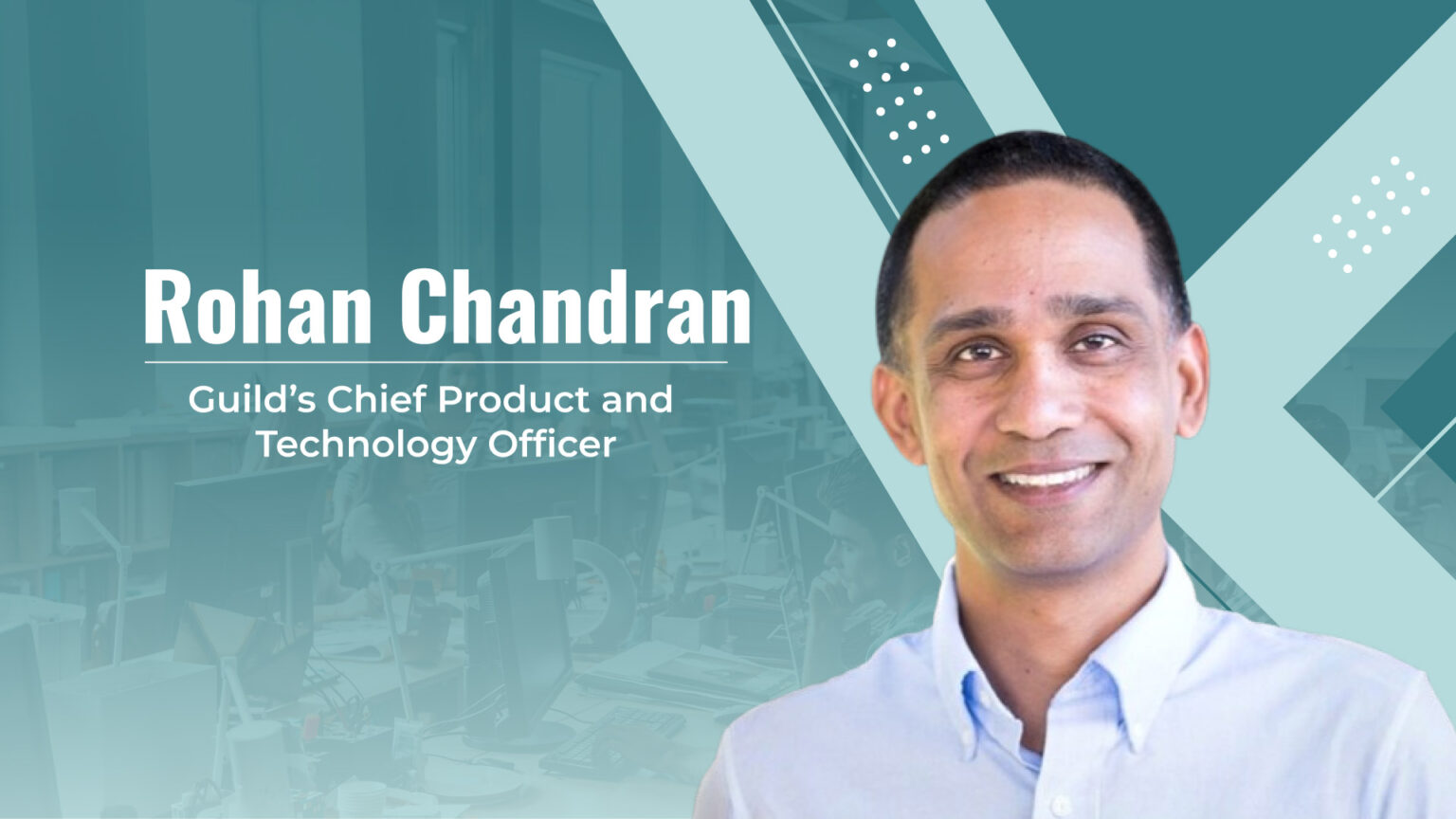
Rohan Chandran, Chief Product & Technology Officer at Guild
Rohan Chandran is the Chief Product & Technology Officer at Guild. Guild enables forward-thinking employers to invest in their employees, unlocking life-changing opportunities for personal and professional growth through education and learning programs, career development, and one-on-one coaching. Chandran is responsible for the company's product and solutions roadmap and strategy, as well as its platform, data, and technology strategies. He was previously the Chief Product Officer at Data Axle and prior to that the Chief Product & Technology Officer at Shopkick. He holds a B.A. in Economics and a B.S. and M.S. in Computer Science from Stanford University.