


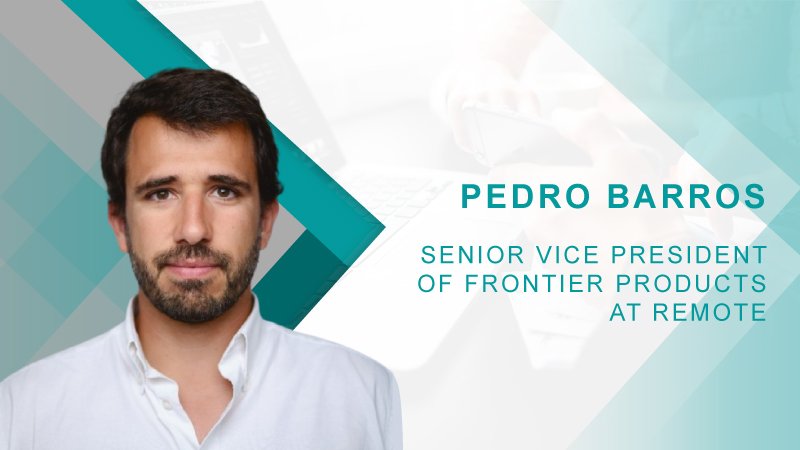
Welcome to HRTech Cube, Pedro. To start, could you walk us through your professional journey and how it led you to your current role at Remote?
My background spans finance, strategy, and operations. Before Remote, I held leadership roles in M&A, BD, and VC, and later joined startups where I focused on scaling global teams and financial operations. At Remote, I’ve worn a few hats over the last five years, from VP of finance to GM of contractors. Today, I lead our Frontiers Products division and oversee things like contractor management and our PEO offering. That cross-functional lens helps me build tools that support growth while keeping compliance, cost, and employee experience in balance.
HR tech has come a long way from siloed solutions to integrated platforms. How do you see this evolution impacting both compliance and employee experience at scale?
The shift from siloed solutions to integrated platforms has been a game changer for the industry. Previously, companies were piecing together payroll, benefits, and compliance from different vendors. Each came with its own workflows and risks. Now, all-in-one solutions give companies a single source of truth, which improves everything from data accuracy to onboarding speed. But more importantly, they reduce the risk of compliance gaps while giving employees a consistent experience, no matter where they live or work.
As someone who’s worked on scaling infrastructure and services for global teams, what are some key lessons you’ve learned that shaped the launch of offerings like Remote PEO?
One of the biggest lessons is that complexity scales faster than headcount. As companies grow across geographies, things like tax registration, employment classifications, and benefits administration can become a bottleneck or source of liability. With Remote PEO, we built something we wished we’d had ourselves: a way for growing U.S. companies to manage HR across multiple states without needing a dedicated internal legal team or multiple vendors.
U.S. startups expanding across state lines often struggle with HR complexity. How does Remote PEO simplify processes like state tax registration, benefits, and compliance for distributed teams?
Startups, especially early-stage ones, sometimes don’t realize that hiring in a new state triggers a long list of compliance steps: registering with tax agencies, adapting benefits to local laws, updating policies – the list goes on. Remote PEO was designed to make this highly efficient for companies. We register and manage state tax IDs, ensure payroll and benefits stay compliant, and provide access to competitive health plans across the United States. Instead of chasing paperwork, companies can focus on building their teams and their offerings.
In your role as SVP Frontier Products, how should companies think about the risks of misclassification and the best practices for choosing between contractor and employee models?
Companies should keep in mind that misclassification is both a legal and operational risk. If you treat a contractor like an employee without the proper framework, you can face penalties, back taxes, or even worker disputes. For example, in 2023, reports surfaced that Nike faced potential tax fines exceeding $530 million due to the misclassification of thousands of temporary office workers. The year prior, Uber agreed to a $100 million settlement for similar violations. To say that the stakes are high is an understatement. That said, contractors can be a flexible and strategic part of your workforce, especially in the early stages. The key is understanding local labor laws and making classification decisions based on actual working relationships, not just convenience. My team at Remote helps companies navigate that decision with tools and guidance built into our platform.
From a strategic perspective, what should CFOs and finance leaders be prioritizing when it comes to scaling HR and compliance systems across global operations?
Three things: cost control, risk mitigation, and speed to execution. Finance leaders need infrastructure that lets them scale without bloating their back office. That means investing in tools that automate compliance and reduce manual overhead while also providing visibility into workforce costs. It’s about building systems that grow with the business and can flex across jurisdictions, especially as the talent pool gets more global.
Can you break down the key differences between PEO and EOR models—and what factors should guide a company’s choice between the two?
In short, a PEO is a co-employment model. You’re still the employer of record, but you share HR responsibilities (payroll, benefits, compliance) with the PEO. It’s ideal for companies hiring in the U.S. that already have a legal entity. An EOR, on the other hand, becomes the legal employer on your behalf. It’s the best route if you’re hiring in a country where you don’t have a legal entity or don’t want to set one up. The choice depends on your footprint and goals. If you’re expanding globally, EOR is faster. If you’re scaling within the U.S. and want to streamline operations, PEO is often your best bet.
What is your personal approach or strategy when navigating the intersection of compliance, operations, and innovation in fast-growing companies?
I start with the UX. Whether that’s an employee trying to enroll in benefits or a CFO pulling a headcount report, our goal is to make the complex feel simple. Then I work backwards to make sure the operational and compliance foundations are solid. Being innovative requires designing systems that are both flexible and reliable.
What advice would you give to founders or HR leaders trying to scale their people operations while keeping costs, compliance, and employee satisfaction in balance?
You don’t need to build everything in-house. In fact, you shouldn’t. Focus on the employee experience you want to offer and then find partners that can help you deliver it compliantly and efficiently. Also, start thinking about compliance early. It’s much easier to build clean systems upfront than to unwind issues later. And lastly, remember that happy employees are your brand ambassadors, especially in a distributed world. Reputation and goodwill are everything.
Finally, any thoughts you’d like to share on what’s next for HR tech, and how companies can future-proof their infrastructure for the global workforce?
We’re moving toward a world where talent is truly borderless, and HR tech needs to catch up. The future requires intelligent systems that can adapt to new laws, new markets, and new ways of working. I believe the next wave will be about interoperability: platforms that talk to each other, surface insights in real time, and make cross-border hiring as seamless as local onboarding. Companies that invest in that kind of infrastructure today will have a major edge tomorrow.