Welcome to HRTech Cube, Nelson. To begin, can you share your professional journey and what inspired you to co-found HowNow and lead innovation in the learning technology space?
My professional career was actually quite short before I took the leap into entrepreneurship. Over the last two decades, I’ve built businesses in film, hospitality and technology, but the driving force behind HowNow came from witnessing the skills crisis first-hand. It was clear to me that too many people were at risk of becoming socially and economically irrelevant if they didn’t continue learning. I could see this even among my own friends and family. That reality, combined with my core belief that equipping people with the right knowledge, skills and mindset is the mother of all problems to solve, inspired me to start HowNow. If we can crack this, we can positively influence some of the biggest challenges we face globally, from inequality to climate change.
You often speak about the “three Cs of upskilling” – content, context, and conversation. Can you break down how each plays a critical role in effective learning at scale?
Yes, absolutely. Content provides the knowledge and frameworks that form the foundation of learning. Context ensures learning is relevant to the learner’s role, skill level, challenges, and environment. And conversation represents the two-way dialogue, teaching, feedback, and guidance that learners need in order to make sense of the content they’re consuming.
Modern learning solutions might offer one or two of these but very few deliver all three – and so they fail to build real capability. Content without context is simply noise. Context without conversation is static, and conversation without content lacks substance. But when all three of these are present and connected, learners can bridge the gap between learning and doing.
Digital learning has solved the content challenge, and AI is helping with context. Why has “conversation” been the hardest to scale, and why do you believe it’s the missing piece in upskilling?
When we talk about conversation in the context of learning, what we’re really talking about is great teaching, coaching, and mentoring. We’ve always known that this delivers the biggest impact in learning and upskilling terms – the problem is, it’s always been expensive and difficult to scale. Until now.
For the first time, AI learning agents are enabling organisations to scale hyper-personalised teaching. Employees across all job roles, industries, and seniority can access their own 24/7 personal tutor and subject matter expert. Someone who can understand their skills gaps and goals, and who can teach, coach and enable them based on verified expertise and sound pedagogy.
You recently launched HowNow Guru, an AI learning agent. How does Guru address L&D’s biggest challenge—delivering great teaching at scale?
The biggest challenge in L&D has always been scaling the kind of one-to-one teaching that truly works. Throughout history, the greatest teachers haven’t just delivered content – they’ve made it meaningful through dialogue, adapting to the learner’s needs, providing instant feedback, and challenging at just the right level. Every word is tailored to the individual. The problem is, that kind of personalised teaching has always been incredibly human-intensive and impossible to scale.
That’s exactly what HowNow Guru changes. It’s a purpose-built AI agent designed to teach, coach and enable people through dynamic, multi-modal experiences that are grounded in pedagogy and powered by verified expertise. For the first time, everyone can have access to an expert who doesn’t just know the subject, but knows how to teach and coach like the greatest teachers in history—at scale.
Unlike traditional platforms, Guru acts as an always-on coach. Can you share examples of how features like role-play simulations, feedback loops, or linked insights are transforming learning experiences?
Most workplace learning today is knowledge-based—it’s like watching videos on how to ride a bike without ever getting on one. You don’t build skills by just consuming content, you build them by practising. This is where Guru is different. With role-play simulations, employees can practise real-world scenarios in a safe space, whether it’s running their first one-to-one as a new manager or learning how to write an effective AI prompt and receiving instant, tailored feedback to accelerate their progress.
Guru also makes it effortless to go deeper into topics. It can generate personalised deep dives, highlight key concepts you might not know, and let you ask follow-up questions with a single click so you can explore and learn without breaking flow. And because reinforcement is just as important as practice, Guru delivers adaptive knowledge checks that help people retain what they’ve learned, from product knowledge to critical processes. Together, these features move learning from passive content consumption to active skill-building.
Skills are now at the top of most business strategies for 2026. How is AI-powered skills mapping helping organizations better understand gaps and align development with business objectives?
The rate of knowledge change is now so fast that, for most organisations, it’s no longer feasible to keep buying new skills via recruitment. The only sustainable option is to build skills within the business. To do this strategically, leaders need to ask themselves three questions:
– Which skills do our people need over the next year?
– Which of these skills do they have now?
– How do we close the gaps?
AI skills mapping enables organisations to accurately answer these questions within weeks, rather than months, providing leaders with a clear view on how they need to develop their people to drive performance and support company goals.
What challenges do organizations face when adopting AI-driven learning tools, and how can leaders build trust and adoption among employees?
As with any AI-enabled technology, organisations must prioritise a responsible approach – especially when it comes to the protection of people’s personal data and privacy. Organisations should be asking any prospective technology provider how they use AI and what guardrails they have in place to ensure alignment with their organisation’s own policies.
Perhaps the most obvious consideration is the integrity of the data that AI learning agents use. Working to the gold standard – and to build the requisite trust that drives long-term learner engagement – AI learning tools must be underpinned by verified knowledge and resources. The importance of choosing relevant and trusted learning content partners is therefore paramount.
On a personal level, what core strategy or mindset has helped you navigate fast-changing markets and stay ahead as an innovator in corporate learning?
For me, it comes down to two things: mindset and curiosity. I’ve always believed in adopting a growth mindset. Being open to failure and treating it as a learning opportunity. The reality is, you’ll get more things wrong than right, but when you get the right things right, it more than makes up for the rest. I make a point of reflecting on every failure and asking what I could have learned sooner, and that mindset has become part of HowNow’s culture. It’s what helps us stay agile and innovate.
The other piece is curiosity. I ask a lot of questions, sometimes to my friends’ dismay! But I think in today’s world, asking the right questions is often more important than having all the answers. That curiosity is what keeps me pushing boundaries and rethinking how corporate learning can work.
For L&D leaders who feel overwhelmed by the rapid rise of AI, what advice would you give them to start integrating AI into their learning strategies effectively?
Start with the problem, not the technology. Using AI for the sake of it won’t create value so anchor it to a real challenge you want to solve. That could be something small, like using AI to analyse learner feedback and highlight improvement areas, or mapping your critical roles to skills and proficiency levels. Think big, but start small.
AI adoption in learning works like a flywheel: every turn builds more momentum. Don’t wait for a “big bang” transformation, and don’t shut yourself away from it either. Stay open, stay curious and in many ways, embrace the role of ‘Chief Tinkering Officer’. The more you experiment, the quicker you’ll see how AI can help you create real impact.
Finally, as you look to the future, what closing thoughts would you like to share on how AI will redefine learning, upskilling, and workforce development over the next few years?
I believe learning and upskilling will be one of the biggest areas transformed by AI in the years ahead. The exciting part is that very soon, everyone could have their own AI learning agent who knows what they need to learn, when they need to learn it, and who can deliver tailored, dynamic experiences that actually drive skills development and behaviour change.
In my book Learning at Speed, I talk about how in an era of exponential change, the fastest learners will win. The people and organisations who keep learning, who can navigate uncertainty and turn change into opportunity, will be the ones who win. AI will be the great accelerator here, and those who embrace it for learning will set themselves apart from those who don’t. Quite simply, using AI to learn will separate the winners from the losers.

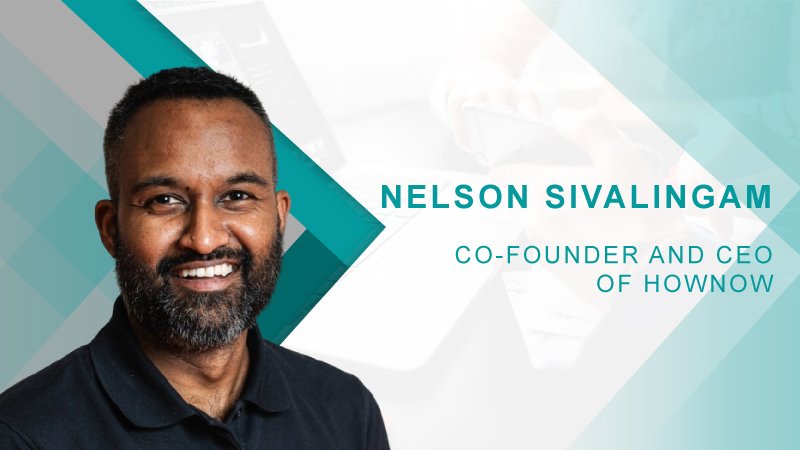
Nelson Sivalingam, Co-Founder and CEO of HowNow
Nelson Sivalingam is Co-Founder and CEO of HowNow - the learning and upskilling platform that helps organisations to connect every employee with skills-led learning, using AI agents in the flow of work. He is also the author of award-winning book Learning at Speed, and co-host of the popular L&D Disrupt podcast. Nelson has been recognised by Virgin Media Business as one of the top 30 young innovative founders in the UK, and recently featured on Bloomberg's Entrepreneurial Mindset documentary.