

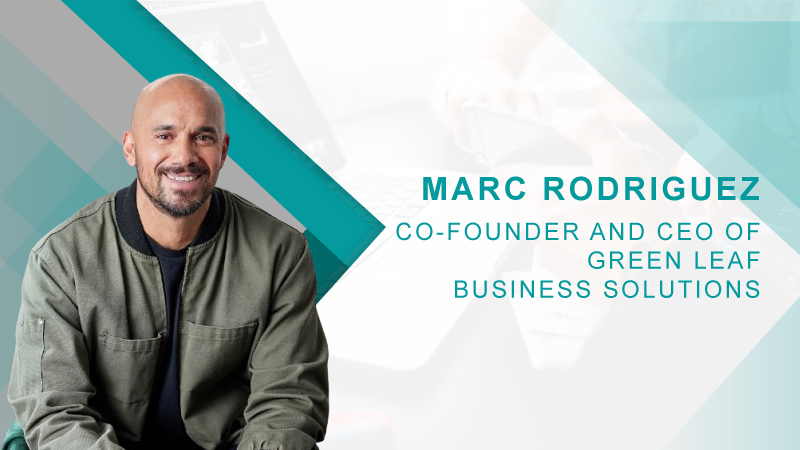

Welcome to HRTech Cube, Marc. We’re delighted to have you. Can you walk us through your professional journey and the specific market gaps that led you to co-found Green Leaf Business Solutions?
My background has always been rooted in helping entrepreneurs scale responsibly. Early in my career, I saw firsthand how fast-growing companies, particularly in regulated industries were forced to stitch together payroll, HR, compliance, and benefits through disconnected providers.
When cannabis markets began expanding state by state, that fragmentation became even more dangerous. Operators were navigating complex tax structures, multi-EIN environments, evolving labor laws, and heightened regulatory scrutiny, often with entry-level HR tools designed for startups.
The gap was clear: there wasn’t a compliance-first, infrastructure-focused workforce partner built specifically for high-growth, regulated industries.
We founded Green Leaf Business Solutions to change that, combining payroll, HR technology, benefits, and managed HR services into one integrated ecosystem. Not just software. Not just processing. True workforce infrastructure.
At what headcount or complexity threshold do early-stage “survival” HR systems turn from assets into active liabilities for scaling companies?
It’s rarely just headcount, it’s complexity.
For many companies, that tipping point happens between 25 and 75 employees, especially when:
- They expand into a second state
- They hire variable-hour or seasonal workers
- They add multiple EINs or business entities
- They introduce benefits or retirement plans
- They begin attracting institutional investors
At that stage, “survival systems”, spreadsheets, entry-level payroll platforms, manual compliance tracking , stop being scrappy solutions and start becoming audit risks.
What worked at 10 employees becomes an operational liability at 50. And by 100, the cost of correcting mistakes is exponentially higher than the cost of building correctly from the beginning.
How does workforce infrastructure directly impact operational resilience and expansion timelines, particularly when entering new multi-state territories?
Expansion speed is directly tied to infrastructure maturity.
When entering new states, companies must navigate:
- State-specific labor laws
- Tax registrations
- Workers’ compensation structures
- Benefits mandates
- Leave compliance
- Wage and hour differences
If workforce systems aren’t architected to scale across jurisdictions, expansion stalls.
Proper infrastructure means:
- Centralized reporting
- Multi-state compliance automation
- Integrated benefits administration
- Managed oversight to prevent blind spots
Companies with durable HR infrastructure expand confidently. Those without it expand reactively — and often expensively.
From your perspective, how does the maturity of a company’s HR and payroll technology influence investor confidence and valuation during due diligence?
During due diligence, investors are evaluating risk just as much as growth potential.
We consistently see investor teams focus on:
- Wage and hour compliance
- Independent contractor classifications
- Multi-entity payroll accuracy
- ACA compliance
- Tax exposure
- Documentation integrity
If workforce systems are fragmented or manual, that introduces uncertainty — and uncertainty impacts valuation.
When HR and payroll are structured, documented, and audit-ready, it signals operational maturity. It shows leadership understands risk management. That builds confidence and confidence influences both deal velocity and valuation multiples.
What does the cannabis sector teach us about the challenge of professionalizing people operations without “flattening” the unique culture that made a brand successful?
Cannabis operators built their brands on passion, community, and authenticity.
The challenge isn’t replacing that culture with corporate structure, it’s protecting it through structure.
Professionalizing people operations doesn’t mean removing personality. It means:
- Clear policies that create fairness
- Compliance guardrails that protect jobs
- Scalable systems that prevent burnout
- Leadership frameworks that enable growth
The goal is not corporate rigidity, it’s sustainable freedom.
What are the signs that a founder has become a bottleneck in HR processes, and how do durable systems facilitate the shift away from founder-led problem solving?
You know a founder has become a bottleneck when:
- Every hiring decision requires their approval
- Payroll questions go directly to them
- Policies are informal or inconsistent
- Employees bypass HR to “just ask the founder”
- Compliance decisions are reactive
Founder-led problem solving works early on. But it’s not scalable.
Durable systems allow founders to transition from operator to architect. Clear workflows, delegated authority, documented processes, and managed HR oversight free founders to focus on strategy instead of troubleshooting payroll issues at 10 p.m.
How should leaders architect their HR systems to ensure they remain agile enough to launch in new states without needing to rebuild their compliance framework?
Leaders should think modular, not patchwork.
That means:
- Implementing technology that supports multi-state payroll from day one
- Structuring employee classifications correctly at the outset
- Centralizing compliance documentation
- Building benefits plans that accommodate multi-jurisdictional mandates
- Leveraging managed services to continuously monitor regulatory shifts
Agility comes from intentional design, not from reacting to each new state as a standalone project.
On a personal level, what specific strategy or framework do you use to make high-stakes decisions in such a complex regulatory landscape?
I focus on three filters:
- Regulatory durability – Will this decision hold up across jurisdictions and audits?
- Operational scalability – Does this solution grow with the business?
- Reputational protection – Would I be comfortable defending this decision publicly or to regulators?
If a strategy clears those three filters, it’s usually the right long-term move — even if it’s not the easiest short-term option.
What is one piece of actionable advice for leaders in regulated industries regarding their technology roadmap for the next 12 months?
Stop thinking about payroll and HR as back-office functions — start treating them as core infrastructure.
Over the next 12 months, leaders should:
- Audit their compliance exposure
- Evaluate whether their systems are multi-state ready
- Assess data integration gaps
- Identify where human oversight is missing
Technology alone is not the solution. Technology paired with managed oversight is what creates resilience.
Finally, are there any closing thoughts or upcoming trends in workforce management that you believe will define the next few years?
We’re entering a period where regulatory complexity is increasing, not decreasing, across cannabis and beyond.
Three trends will define the next few years:
- Greater IRS and state-level audit scrutiny
- Increased employee classification enforcement
- Higher investor expectations around operational transparency
The companies that win will not be the ones that move the fastest — but the ones that build the strongest foundations.
Workforce infrastructure is no longer optional. It’s a competitive advantage.
Marc Rodriguez, Co-Founder and CEO of Green Leaf Business Solutions
Marc Rodriguez is the visionary CEO and Co-Founder of Green Leaf Payroll & Business Solutions Inc., a nationwide payroll firm dedicated to providing compliant payroll, HR outsourcing, and financial solutions for the cannabis industry. With a career spanning sales leadership and operational management, Marc has consistently demonstrated his ability to bridge complex industry needs with innovative solutions.