

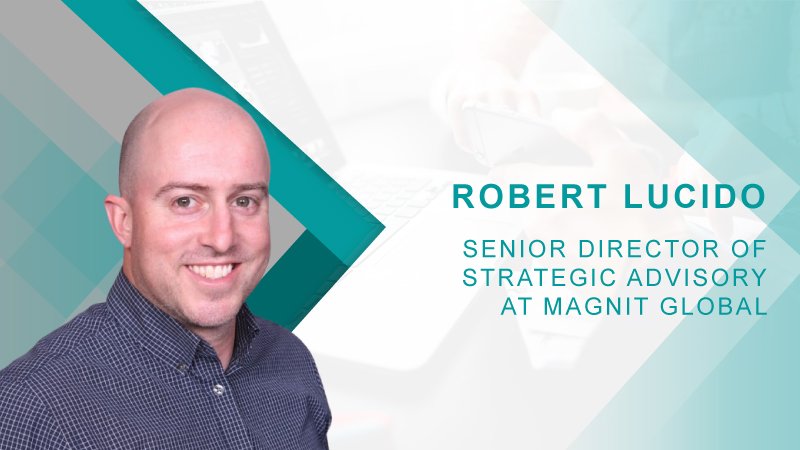

Welcome to HRTech Cube, Robert, we’re delighted to have you. To start, can you walk us through your professional journey and how it led you to your current role at Magnit?
My career has been centered around a desire to help business leaders optimize their workforce in furtherance of their strategic goals. Every step of the way, I’ve put an emphasis on leadership, performance reporting, accounting and operations, workforce analytics consulting, and honing my experience across industries.
At State Street I worked my way up from an Associate in Fund Accounting to Finance Manager over the course of a decade before landing at Magnit Global as a Senior Business Consultant in 2017. It was here that I found my niche in market intelligence for workforce strategy and human capital management, culminating in my current role as the Senior Director of Strategic Advisory. In this position, I’m proud to play a part in helping Magnit’s clients transform their talent and diversity goals and adapt to the evolution of work – empowering them to grow their extended workforce with greater agility, transparency, and speed.
The concept of “efficiency above all else” is shaping hiring strategies in today’s uncertain economy. How are organizations adjusting their workforce planning in response to ongoing economic pressures?
The efficiency-first mindset is a defining characteristic of today’s labor market. Global GDP growth is slowing, having risen just 2.3% year-over-year as of Q1 2026 according to IMF estimates. Projections also suggest continued volatility in commodity and shipping costs, meaning organizations are operating under sustained pressure to balance innovation and profitability. So, even though expansion isn’t completely off the table, most enterprises are being cautious amid margin compression.
Vetting, hiring, and onboarding new talent is expensive, both in time and money. For businesses trying to offset downstream pricing triggers and tariff-related economic volatility with the need to be profitable and innovative, these investments often need clearer ROI justification.
In response, organizations are renewing their focus on optimizing existing employees. Automation, AI-backed productivity tools, and targeted upskilling programs are common tactics. The ability to “do more with less” isn’t just efficiency rhetoric anymore. It has become the baseline for sustainable growth.
Contingent and SOW-based contractors are increasingly being leveraged. What are the biggest advantages of these flexible talent models for companies trying to balance cost, speed, and quality?
Alternative workforce models have proven essential for maintaining agility. There is a lot of value in the stability of a traditional, full-time workforce, but that stability can quickly turn into rigidity, which has real costs in an economy that changes so quickly. Investing in contingent workers or Statement of Work (SOW)-based engagements allow companies to better align labor spend and planning with shifting business priorities.
Organizations are increasingly using contingent talent to handle immediate deliverables or projects with the same quality as a full-time employee, but without long-term overhead, as well as fill specialized skills gaps. Technology changes fast and so do the most in-demand skillsets on any given day. For instance, according to Magnit’s proprietary data, demand for AI engineers and automation specialists through contingent channels rose 19% year-over-year as of February 2026. Internal upskilling programs can help, but when an organization needs not just the skill, but experience, short-term workers are an effective solution.
Beyond the organization, it’s important to note the appeal this model has for candidates. As professionals seek project variety and faster skills growth, contingent work has become a career accelerant rather than a fallback.
How do tariffs and other external economic factors influence how companies structure their workforce, both now and looking ahead?
Tariffs have evolved from a trade or policy issue alone to an important variable in workforce strategy. Global trade tensions are reshaping the cost of doing business, with intensified price triggers and supply chain disruptions for electronics, auto parts, and semiconductors. As these effects ripple downstream, budgets for headcount expansion and accelerating automation initiatives are tightening.
In the immediacy, companies are taking a step back to assess skill inventories and regional risk exposure, asking “do we have the right people in the right places?” Looking further ahead, workforce resiliency will hinge on strategic diversification, both geographically and by skill type. The businesses that invest in predictive workforce analytics and nearshoring strategies – particular in Mexico and Eastern Europe – will be best positioned to adapt to a world where trade policy and talent strategy are increasingly intertwined.
What best practices would you recommend for hiring managers who want to stay ahead when it comes to leveraging contingent or project-based talent effectively?
Visibility is everything. From hiring managers to executive leadership, companies need a strong understanding of how economic shifts, like updated tariffs schedules or input cost changes, cascade through business operations and ultimately influence workforce needs. Impact audits ensure workforce decisions align with real business levers, as even well-intentioned adjustments can create problems down the line if done blindly.
Intentional deployment is equally important, as contingent and project-based workers should complement, not compete with core staff. Their focus should be on clear, deliverable-based workstreams where flexible and specialized talent is most essential. When well-defined scopes and evaluation metrics are in place, productivity and engagement among contingent staff rise sharply.
Another best practice is institutionalizing data-driven hiring. Talent intelligence, including real-time market analytics, skill availability, and AI-driven forecasting allow organizations to anticipate changes rather than just react. When combined with proven sourcing strategy and clear governance, that foresight powers more agile staffing decisions – one of the strongest differentiators companies can claim.
How can organizations ensure that contingent workers deliver the same level of quality and impact as full-time employees, especially on critical projects?
Contingent versus full-time is not what determines the quality of outcomes. Approach is everything, and it is almost entirely dependent on clarity and integration. Clearly defined project scope, performance metrics, and structured onboarding are key.
When contingent labor is embedded within a cohesive, data-driven workforce strategy and not managed in isolation, it creates alignment that reduces task redundancy and boosts both accountability and outcome quality. A recent benchmarking report of Magnit’s clients showed that project teams blending contingent and full-time talent under unified KPIs delivered projects 14% faster on average than traditional setups.
On a personal level, how do you approach workforce strategy when advising companies in a rapidly shifting economic and regulatory environment?
My approach begins with proactive planning that’s anchored in workforce intelligence. The goal shouldn’t be to try and predict volatility, as that’s nearly impossible to do accurately. Instead, businesses should be doing what they can to build up their comfort operating within the uncertainty.
That means combining agile hiring models with real-time labor market analytics, to make it easier to pivot ahead of disruptions as opposed to after they happen and cause damage. Trade policy is likely to remain a major unknown going forward, so I focus on resilience, diversified talent channels, nearshoring where viable, and consistent internal development to fill future gaps. Complete stability may be unattainable, but workforce readiness is entirely achievable.
What trends are you seeing in workforce strategy that companies should be preparing for over the next few years?
Businesses across industries are becoming more hesitant – hesitant to hire, take risks, and spend money. However, this “strategic caution” can’t mean a complete stagnation of growth if companies want to remain competitive. It’s about finding ways to encourage innovation without exorbitant costs.
We’re seeing this pullback give rise to more structured, data-based workforce planning. U.S. core inflation fell below 3% in February for the first time since mid-2021, so as they start to stabilize, organizations are redirecting costs savings into selective innovation.
Additionally, transparent communication and clear alignment between workforce planning and business objectives are critical. HR, procurement teams, and executive leadership must be in lockstep and rely on data-driven insights to fully correlate workforce strategy to business outcomes, not just recruiting cycles, and successfully navigate these shifts.
For professionals considering or already working in contingent roles, what advice would you offer to maximize opportunities and navigate this evolving employment landscape?
In a cooling full-time job market, project-based roles provide an opportunity to continue earning, learning, and expanding real-world experience. The professionals succeeding right now are demonstrating rapid adaptability and value delivery, as well as their capability to integrate into new teams and contribute meaningful results, quickly.
The complement to these short-term work models is upskilling. As economic conditions and supply chains shift, new job titles and highly coveted skills will too. AI literacy, data acumen, and systems automation in particular are in high demand so far this year. Upskilling has long since stopped being a nice-to-have and has transformed into a reinvestment strategy for continued employability in a landscape that prizes flexibility and precision.
Finally, are there any final thoughts you’d like to share with HRTech Cube readers about the future of workforce strategy and talent management?
We’re entering a phase where economic uncertainty and workforce innovation are proceeding in parallel. Organizations no longer have the luxury of waiting for the world to stabilize before they act. Instead, the future of workforce strategy is about fluidity, treating workforce design as a living system that adjusts in real time to market conditions. Those embracing technology-enabled visibility, flexible hiring models, and continuous skill alignment will not only weather economic volatility but also turn it into an advantage.

Robert Lucido, Senior Director of Strategic Advisory at Magnit Global
As the Senior Director of Magnit Global’s Strategic Advisory, Robert Lucido oversees the team responsible for analytics and advisory consulting services for Magnit’s clients across clinical, commercial, and market intelligence settings. Specializing in the strategic design and implementation of market research projects in the human capital management market and contingent workforce, Robert brings extensive experience in providing actionable insights and advice on talent management, recruitment, retention, and organizational design. Prior to Magnit, Robert spent 10 years at State Street, operating in several positions across financial management.