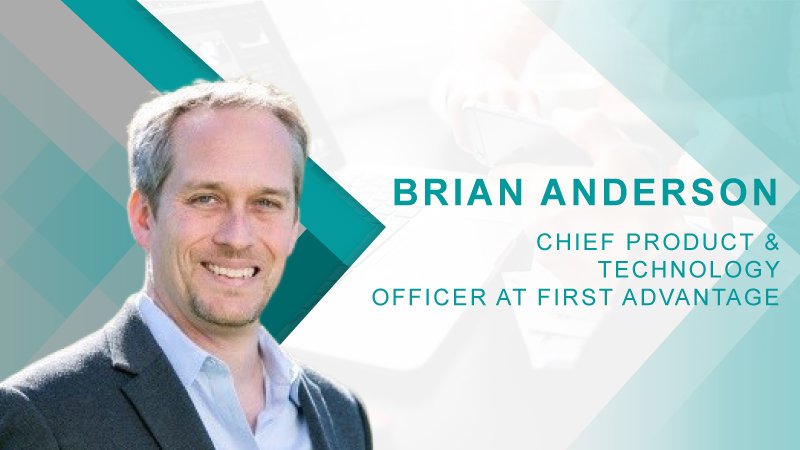
Welcome to HRTech Cube, >Brian — we’re delighted to have you. To start, could you walk us through your professional journey and how it led you to becoming Chief Product and Technology Officer at First Advantage?
I’ve spent over 25 years in enterprise software, moving between hands-on engineering, consulting, and executive leadership roles. Along the way I’ve focused on building scalable platforms, unifying complex product portfolios, and applying cloud, AI, and machine learning to deliver real outcomes for customers.
Most recently, I served as Chief Technology Officer for the Digital Solutions division at Tyler Technologies, where I helped accelerate innovation and digital service delivery following Tyler’s acquisition of NIC Inc. in 2021. That experience—leading through integration at significant scale—sharpened my perspective on how to bring disparate teams and technologies together around a clear product strategy and customer experience.
Before Tyler, I held the CTO role at Lexmark, co-founded the SaaS startup Applogie, and served in technical and product positions at Tradebot Systems, Perceptive Software, and Cerner. Across these chapters, the common thread has been building high-performing teams that marry thoughtful product design with disciplined engineering, while protecting data integrity and reliability at scale.
First Advantage plays a major role in delivering trusted background screening and identity solutions. What excites you most about leading the organization at this stage of its growth?
I’m energized by the opportunity to scale our trusted background screening and identity solutions at a moment when the challenges in this dynamic market are highlighted by evolving risks. Our customers are facing a situation where hiring must be fast while they remain confident. What sets First Advantage apart is our ability to deliver identity insight across the entire employment lifecycle—not just telling organizations who someone was, but who they are making an offer to right now. That differentiation, coupled with our global scale and data, positions us to successfully help our customers.
For me this stage is about turning identity into a continuous, trusted capability for every employer, delivering speed and certainty at scale. That mission, and the impact we can have for customers and candidates worldwide, is what excites me most.
How do you see technology reshaping the screening, identity, and workforce risk-management landscape over the next few years?
Over the next few years, technology will fundamentally shift this space from static checks to dynamic, continuous trust frameworks. Three big trends stand out:
- Identity and risk signals
Screening will move beyond “point-in-time” to continuous monitoring, leveraging global data networks and advanced identity verification to surface changes in risk profiles instantly. This means employers won’t just need to know who someone was, they’ll need to know who they are now. The leader in this market will have the technology and data assets to answer that key question. - AI-driven intelligence with human oversight
Responsible AI will accelerate document validation, fraud detection, and pattern recognition, reducing turnaround times while improving consistency in execution. Importantly, AI will augment, not replace, human judgment, compliance and fairness. - Integrated, mobile-first experiences
Candidate expectations for speed and transparency will drive mobile workflows, multilingual support, and deep integrations with HRIS and ATS platforms. This creates frictionless onboarding while maintaining rigorous compliance. The workforce is more global now than ever. Technology will continue to create a broader candidate pool and fuel the growth of your business.
In short, technology will transform screening and identity from a back-office process into a strategic, risk-management capability, enabling organizations to hire smarter, faster, and safer at a global scale.
As workplace expectations shift, how is First Advantage adapting to better support employers and employees in a rapidly evolving labor market?
Workplace expectations are shifting toward speed, transparency, and tailored experiences, and we’re meeting that change by doubling down on vertical-specific solutions. Rather than a one-size-fits-all approach, First Advantage delivers industry-aligned screening and identity workflows that reflect the unique compliance, risk, and candidate experience needs of sectors like healthcare, the gig economy, financial services, retail, and transportation.
For example:
- Healthcare: Credentialing and license verification integrated with regulatory checks.
- Gig & On-Demand: Mobile-first onboarding with identity verification for high-volume hiring.
- Financial Services: Enhanced identity-fraud detection and continuous monitoring for sensitive roles.
This vertical strategy allows employers to see faster time-to-hire and stronger compliance, while employees benefit from streamlined, mobile experiences in their language. Combined with our best of breed platform, deep ATS integrations, and responsible AI capabilities, we’re transforming screening from a back-office process into a strategic enabler of workforce agility.
Technology will keep accelerating but trust, identity, and human‑centered design will define who thrives.
Innovation is a major focus for your team. What areas of product development or customer experience are you prioritizing to stay ahead of industry needs?
A few themes are front and center for us right now. First, we’re doubling down on our best-of-breed strategy and unifying the customer and candidate experience. We’re building a more mobile-first, multilingual, integrated experience layer so candidates and recruiters can move through the process more smoothly, with clearer insights and fewer hand-offs.
We’re also prioritizing identity and screening convergence, bringing identity closer to our other products so customers get a full, trustworthy view of who they’re hiring. This includes offering identity verification checkpoints across all stages of the candidate and employee lifecycle. And of course, GenAI and data-driven capabilities continue to be a huge accelerator for us. We’re modernizing core platforms, rolling out shared services, consolidating legacy systems, and using AI to speed decisioning, enhance consistency, and reduce manual processes.
Compliance demands continue to expand globally. What guidance do you offer organizations navigating complex, multi-jurisdictional background screening and hiring regulations?
Navigating global compliance really comes down to two things: local expertise and consistent, scalable processes. The regulatory landscape shifts constantly, and every country has its own rules around data, identity, criminal checks, and what employers can and cannot do. That’s why I encourage organizations to anchor themselves in partners and processes built for global complexity.
At First Advantage, we support customers through a layered global compliance model with dedicated Global, Regional, and Local Compliance Officers backed by documented protocols and automated controls. This structure helps companies keep pace with fast-moving legal and regulatory changes while making sure that screenings remain both compliant and operationally efficient.
Ultimately, my guidance is simple: build compliance into the process early, rely on localized expertise, and use technology and automation to mitigate risk. That’s how companies can stay ahead of global complexity while protecting their brand, people, and hiring outcomes.
Trust and data security are mission-critical in your industry. How does First Advantage prioritize accuracy, integrity, and responsible use of data at scale?
At First Advantage, trust starts with how we handle data – accurately, securely, and transparently, across every part of the hiring lifecycle. A few principles guide our approach.
First, we’ve built multi-layered security controls and governance into our internal processes. For example, we operate with a formal Responsible AI framework and documented policies that emphasize transparency, privacy protection, and strict control over data usage. We don’t use customer data to train AI models, and we never use AI to make screening or hiring decisions, only to support human judgement.
To strengthen external trust, we launched the “First Advantage Trust Center”, a publicly accessible hub that centralizes information on our security posture, certifications, and policies. It also includes AI-assisted customer security questionnaires that dramatically reduce review turnaround times, from weeks to in some cases, a single day, while maintaining human oversight. This gives customers immediate visibility into how we safeguard their data and uphold integrity across our systems.
Finally, across global regions we adhere tightly to applicable laws and regulatory requirements, including GDPR and other national data protection and privacy laws, and maintain controls around data accuracy, access rights, confidentiality, and retention.
Altogether, our approach blends responsible technology, rigorous security architecture, and transparent communication, so organizations can rely on us to protect their data and deliver trusted, high-integrity screening outcomes on a global scale.
On a personal level, what leadership strategy or mindset has been most impactful in shaping your approach to decision-making and organizational growth?
For me, the most impactful leadership mindset has been staying grounded in clarity, alignment, and empowerment. I’ve learned that large-scale transformation only succeeds when teams deeply understand the vision, feel connected to it, and are trusted to execute with autonomy.
Equally important is pushing accountability and ownership as low in the organization as possible, breaking down legacy boundaries, and fostering collaboration across functions. That approach not only accelerates problem-solving but also strengthens cross-team trust.
Finally, I rely heavily on a “measure what matters” mindset. For example, lagging metrics aren’t enough on their own; leaders need forward-looking indicators to guide growth, ensure focus, and adapt quickly.
Together, these principles, clear vision, empowered teams, and disciplined measurement, shape how I make decisions and how I help organizations grow with purpose and resilience.
For business leaders looking to strengthen their talent acquisition processes, what practical advice would you share to improve efficiency, fairness, and candidate experience?
- Simplify the candidate journey.
Across multiple internal initiatives we’ve seen that reducing friction (mobile-responsive workflows, pre-populated data, intuitive navigation) directly improves completion rates and reduces the time it takes candidates to get through the hiring process. A streamlined experience accelerates hiring while improving fairness by giving every candidate a more accessible, predictable process. - Use data and feedback loops to drive continuous improvement.
Leaders should collect candidate feedback and use it to refine processes, something we’ve embedded into our Candidate Experience where responsible AI helps interpret sentiment and highlight friction points. These insights enable measurable improvements (e.g., fewer drop-offs, faster data collection, more accurate information to be used in screenings). - Lean on responsible technology, not opaque automation.
AI should amplify human decision-making, not replace it. Responsible AI can remove friction, detect issues earlier, and maintain high candidate satisfaction, as long as it’s used transparently and ethically.
If leaders focus on these foundations, clarity, consistency, and responsible use of technology, they can meaningfully improve efficiency and deliver a fairer, more modern candidate experience.
Finally, what closing thoughts would you like to leave our readers with, particularly as they prepare for the future of work, technology, and workforce risk management?
As we look toward the future of work, one thing is clear: technology will keep accelerating, but trust, identity, and human-centered design will define who thrives. The companies that win will be those that embrace innovation responsibly, lean into unified and resilient platforms, and stay adaptive in the face of rapid change. If leaders stay curious, stay transparent, and stay committed to elevating both people and process, they won’t just keep up with the future; they’ll help shape it.

Brian Anderson, Chief Product & Technology Officer at First Advantage
Brian brings over 25 years of experience in enterprise software, spanning engineering, consulting, and executive leadership. He has a proven track record of building scalable platforms, unifying complex product portfolios, and applying cloud, AI, and machine learning to drive customer impact. Before joining First Advantage, he served as CTO for Tyler Technologies’ Digital Solutions division, where he accelerated innovation and led large scale integration efforts following the acquisition of NIC Inc. His earlier roles include CTO at Lexmark, co founder of SaaS startup Applogie, and technical and product leadership positions at Tradebot Systems, Perceptive Software, and Cerner. Across his career, Brian has consistently built high performing teams rooted in disciplined engineering, thoughtful product design, and a commitment to data integrity at scale.