

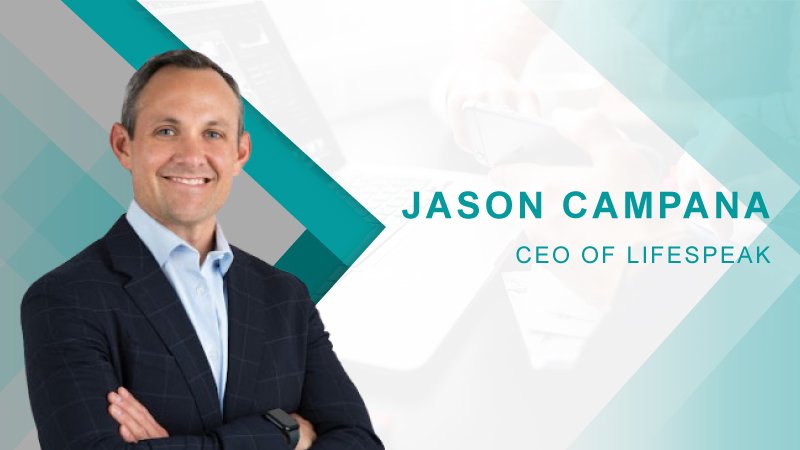

To begin, could you please walk us through your professional journey and what ultimately led you to your role as CEO of LifeSpeak?
I started my journey in entrepreneurship at a young age as a franchise manager with College Pro Painters. I then spent eight years working with the franchisor, where I had the opportunity to recruit, train, and coach hundreds of franchisees – an experience that really shaped my approach to scaling teams and developing talent.
From there, I joined Wellbeats as an early employee to help build out our distribution business. Over time, I moved into leading sales, marketing, and eventually operations as SVP Operations, helping scale the company to over $15 million in ARR. In February 2022, we sold Wellbeats to LifeSpeak.
After the acquisition, I became the COO at LifeSpeak, where I focused on integrating four companies and developing a new product strategy that brought our solutions together into one best-in-class offering. Most recently, we took the company private in June 2025, and following that transaction, I stepped into the role of CEO. It’s been a rewarding journey, and I’m excited about what’s ahead as we continue to evolve and grow our impact in the wellness space.
In your view, why is leadership buy-in so critical for embedding wellness into company culture, and how can middle managers play a key role in normalizing proactive health practices?
Having a leadership team that supports embedding wellness into company culture is important because it sets the tone from the top. When executives prioritize and participate in wellness initiatives, it sends a message that health and wellbeing are a priority for their employees. This can help legitimize wellness programs while also reducing the stigma around engaging with wellness benefits.
Middle managers also play a key role because they act as cultural amplifiers. While an employee might feel encouraged to use a benefit because they see the company’s executives doing so, it’s the middle managers who are embedding it into daily practices and modeling these healthy behaviors. By actively participating in and advocating for proactive health practices like flexible scheduling, mental health check-ins or just the regular use of wellness benefits, managers can normalize wellbeing and create a psychologically safe space for their team. When both senior leaders and middle managers lead by example, wellness becomes embedded in the culture, and participation naturally spreads throughout the organization.
Many organizations still treat wellness as a standalone initiative. What strategies can companies use to integrate holistic well-being into daily operations and employee experiences?
To move beyond treating wellness as a standalone initiative, companies need to integrate wellbeing into their employees’ everyday work lives. Instead of limiting wellness initiatives to HR-led programs, leaders should ensure it is being implemented into core business functions. This could mean incorporating wellbeing into performance discussions, team check-ins or even starting meetings with a short wellness moment. Small, consistent efforts like sharing daily wellness content or running organization-wide challenges can reinforce the idea that wellness is part of how the company operates. Integrating wellbeing into daily operations means shifting from a reactive approach to a proactive culture, where taking care of your health is not an exception, but an expectation.
How can leaders ensure that wellness is not only a program but also part of the organization’s DNA and long-term culture? Leaders can ensure wellness becomes part of an organization’s DNA by treating it as a long-term cultural investment rather than a short-term program. This means embedding wellbeing into leadership values and everyday decision-making instead of isolated perks or one-off initiatives.
To do this, leaders need to model the types of behaviors they want to see, like taking mental health days or setting boundaries around work-life balance. They should also provide managers with the tools and training to make wellness a consistent part of the employee experience at every level. Building a culture of wellness requires consistency and accountability. Wellness should be a part of who a company is, not just something they do.
Beyond traditional healthcare metrics, what indicators do you recommend for effectively measuring the true impact of wellness initiatives—such as engagement, retention, and employee sentiment?
To measure the impact of wellness initiatives, leaders should focus on the employee experience at work. Engagement, retention, absenteeism and participation in wellness programs are important, but so is gathering qualitative feedback through pulse surveys, focus groups, and manager check-ins.
It’s also helpful to track sentiment over time to understand how supported employees feel. The goal should be to connect wellness to broader outcomes like psychological safety, team performance and morale. When employees feel well and cared for, it positively influences the entire culture and helps drive long-term success.
What challenges do companies often face when scaling wellness initiatives, and how can they overcome these obstacles?
One of the biggest challenges companies face when scaling wellness initiatives is maintaining consistency across teams, locations and leadership styles. What works in one part of the organization might not resonate in another. There’s also a risk of wellness feeling like a checkbox if it’s not meaningfully integrated into daily work life.
To overcome these obstacles, companies need a flexible and employee-centered approach that offers a range of options to meet their employees’ diverse needs. Leadership alignment is also key here. When executives and middle managers consistently model and reinforce wellness values, it becomes easier to scale impact without losing authenticity. Listening to employee feedback and iterating on programs over time is what turns a good initiative into a lasting cultural shift.
On a personal level, what strategy or principle guides you when leading teams and driving impact in the wellness space?
One principle that really guides me as a leader, especially in the wellness space, is leading with honesty and humanity. I try to share personal stories about what I’m navigating in my own life, whether that’s caring for my mother who’s living with Alzheimer’s or supporting my son as he manages anxiety. Being open about these experiences helps humanize the conversation around wellness and makes it more relatable. When leaders show that they’re also figuring things out and prioritizing their own wellbeing, it creates space for others to do the same. That level of authenticity is what helps build trust and drives meaningful impact across a team.
For leaders who want to move from “checking the box” on wellness to creating real transformation, what advice would you give them?
For leaders who want to move beyond checking the box on wellness, my advice is to stay committed to investing in preventative solutions and to communicate clearly with employees about why those resources are there. Wellness benefits shouldn’t just be something people turn to in a crisis. The goal is to give employees the tools they need to manage life’s everyday stressors before things escalate to burnout, breakdowns or chronic health issues. It’s all about timing. By making these resources available now, leaders are saying: we recognize how hard it is to balance work and life, and we’re investing in your wellbeing before you reach a breaking point. That proactive mindset is what drives real, lasting transformation.
Finally, as you look ahead, what closing thoughts would you like to share on the future of workplace wellness and its role in shaping more resilient organizations?
Looking ahead, I believe the future of workplace wellness lies in prevention. There are quiet, often overlooked costs affecting businesses every day: absenteeism, burnout, lack of sleep, substance use, caregiving challenges and disengagement. These issues may not always feel urgent, but if left unaddressed, they can escalate into full-blown crises. Investing in preventative wellness solutions helps employees navigate life’s challenges before they reach that breaking point. And beyond supporting employee wellbeing, these investments drive real business value by reducing costly outcomes and building more resilient, high-performing organizations.

Jason Campana, CEO of LifeSpeak
Jason Campana is the Chief Executive Officer of LifeSpeak. With extensive leadership in SaaS and health technology, he is focused on spearheading LifeSpeak's growth and driving measurable outcomes for partners and customers, ensuring LifeSpeak's mission of making preventive wellbeing accessible to everyone a reality. Previously, he served as LifeSpeak’s Chief Operating Officer, and spent more than a decade at Wellbeats, where he served as Senior Vice President of Operations and scaled the company significantly, leading to its acquisition by LifeSpeak in 2022.
Campana graduated from The University of Minnesota’s Carlson School of Management with BAs in International Business and Entrepreneurship. He also earned an Executive MBA from The University of St. Thomas.